
All of the synthetic opioid medications on the market in the
Transmucosal Immediate-Release Fentanyl (TIRF category) are
being phased out, effective September 30, according to an FDA
letter and an August 28 pop-up notice on the TIRF REMS web page. While neither the FDA
nor drug maker Cephalon made an official announcement, the August 2024
letter from the FDA to Cephalon (owned by Teva) appearing in the Drugs@FDA
database reveals that Cephalon is discontinuing all TIRF
medications.
(update: a short notice about the discontinuation was added to
the FDA's
TIRF medications drug class page on September 16 2024.)
TIRF Drugs are Fast-Acting to Treat Severe Pain
TIRF medications dissolve directly in the mouth, allowing for
rapid release of the potent fentanyl. Approved to treat sudden
and severe (breakthrough) cancer pain in patients already on
round-the-clock opioid pain medication, they have been routinely
prescribed off-label for other kinds of pain. A patient who
takes a TIRF medication who is not already "opioid tolerant"
(already on another opioid drug like oxycodone) may suffer an
overdose or overdose-related death. The medications in the
category include:
-
Actiq: A "lozenge" that some people call a "lollipop"
because of its stick and berry-flavored "candy" structure. It is
administered in between the gum and the side of the cheek.
-
Fentora: A "disintegrating" tablet that is administered
"bucally" between the gum and cheek or sublingually (under the tongue).
-
Fentanyl Citrate: These include generic
versions of Actiq and Fentora.

Above: Example Images of TIRF medications (Source:
Opiate Addiction Resource)
REMS for TIRF Medications
The FDA-approved Risk Evaluation and Modification System (REMS) for TIRF medications began in 2011 and was modified in 2020 as a way to help ensure that patients taking drugs in the category are already opioid-tolerant (taking regular oral or injected opioid medications for at least 7 days or more). Patients, providers, and pharmacies had to be registered with the REMS program before medication was dispensed. Now that the drugs are being discontinued, the patient is greeted with a pop-up message on the website that explains the program update:
Key information from the notice:
Patients
currently enrolled in the TIRF REMS may continue their TIRF
therapy while supplies remain.
Prescribers currently certified in the TIRF REMS may continue to prescribe TIRF therapy for their currently enrolled patients while supplies remain but must begin working with their patients to transition to other non-TIRF treatments.
Pharmacies currently certified in the TIRF REMS may continue to obtain RDAs to dispense TIRF products to patients while supplies remain.
The TIRF REMS will no longer accept new enrollments for
patients, prescribers, pharmacies or wholesaler-distributors.
Read the complete update here:
https://www.tirfremsaccess.com/home
Why are the TIRF Meds being Discontinued?
The TIRF REMS website and the publicly posted letter from the FDA to Cephalon do not explain why the meds are being discontinued, but here are some likely reasons:
- >Teva (owner of Cephalon) recently settled a number of lawsuits related to the way it promoted its opioid medications, including Actiq. The most recent settlement ($80 million announced in September 2024) was directly with the city of Baltimore, who opted out of Teva's national $4.25 billion opioid settlement deal last year.
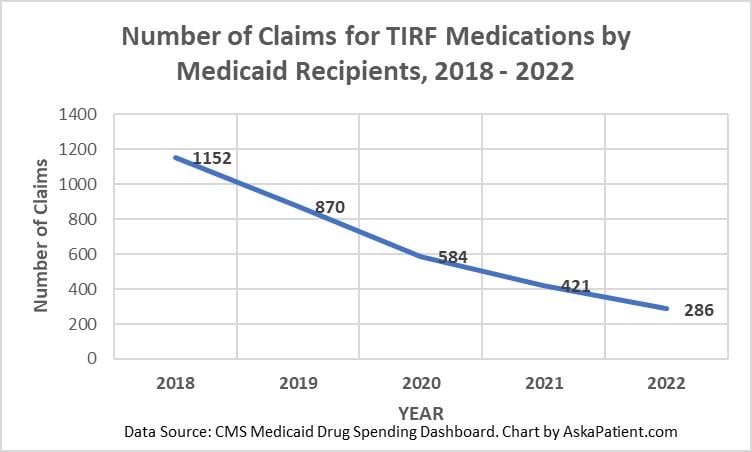
- >Medicare and Medicaid claims data show a significant decrease in beneficiaries receiving fentanyl citrate since 2018. Most likely the private sector also has seen decreased in prescriptions. It is probably not profitable for Cephalon and generics companies to continue to manufacture the drugs. (See graphs below.)
- >The Drug Enforcement Administration (DEA) is aiming to decrease the supply of fentanyl-containing medicines in the U.S.
- >Cephalon and generics companies may not want to deal with the regulatory red tape of REMS, lawsuits over opioid distribution, and reduced sales.
- >Many side effects have been reported for these quick release fentanyl products. For example, patients have reported dental problems: including reports of tooth decay and teeth falling out.
- >Addiction, overdoses, and overdose deaths have been reported in conjunction with use of these potent pain drugs.
- >In spite of the REMS guardrails, many patients have used the drugs without already being opioid tolerant, leading to a dangerous situation. (A 2019 study published in JAMA found that 34.6% to 55.4% of patients prescribed TIRFs were opioid-nontolerant.)
- >These drugs are heavily used off-label. For example, on the Ask a Patient website, the vast majority of reviewers do not report using Actiq for breakthrough pain from cancer. The FDA tightened the prescribing guidelines for these medications and updated the REMs in 2020. A study published in Pain Medicine in 2008 suggested that 90% of the prescriptions written were for off-label use.
Medicare Part D and Medicaid Prescriptions and Claims for TIRF Meds
The chart below shows the decline in the number of patients (beneficiaries)
receiving fentanyl-containing TIRF meds.
The TIRF medications covered include Fentanyl Citrate, Fentora, Lazanda, and Subsys.

For the chart below, for Medicaid recipients, the drugs include Actiq, Fentanyl Citrate, and Fentora. Note that this chart is for the number of claims, not the number of patients. (The CMS dashboard does not provide the same data points for Medicaid that it does for Medicare.)
Other TIRF drugs that have been previously discontinued:
Subsys, a fentanyl citrate sublingual spray, Lazanda (fentanyl citrate) nasal spray, and Onsolis (fentanyl citrate) buccal.
What will patients do who rely on these medications?
Unfortunately, the REMS site offers no guidance to patients or healthcare providers on what substitute medications can be used.
More Reading and Sources:
| Definitions and explanations of different categories of opioids are available at Opioid Addiction Resource website. For example, it explains that Fentanyl is about 100 times more potent than morphine and was first used in the 1960s as an anesthetic under the brand name Sublimaze. "It was not until the mid-1990s that fentanyl was introduced for widespread use with the introduction of a transdermal patch under the brand name Duragesic."(Note that Duragesic has since been discontinued, but generic versions of fentanyl patch are still available, though are often in short supply.) Fentanyl and fentanyl citrate are also still available in injectable form for use in hospitals and by healthcare providers. https://www.opiateaddictionresource.com/opiates/types_of_opioids/fentanyl/ |
FDA Q & A on TIRF medications from December 2020 https://www.fda.gov/drugs/information-drug-class/questions-and-answers-fda-approves-class-risk-evaluation-and-mitigation-strategy-rems-transmucosal |
|
FDA REMS Information for TIRF drugs has a timetable of changes to
the REMS: https://www.accessdata.fda.gov/scripts/cder/rems/index.cfm?event=RemsDetails.page&REMS=60#tabs-3 |
|
Revised REMS
from 2020:
https://www.fda.gov/news-events/press-announcements/fda-takes-further-steps-confront-opioid-crisis-through-risk-evaluation-and-mitigation-strategy |
|
Study on the REMS:
https://www.ncbi.nlm.nih.gov/pmc/articles/PMC6439622/ |
|
Patient Reviews of Actiq:
https://www.askapatient.com/viewrating.asp?drug=20747&name=ACTIQ |
|
Patient Reviews of Fentora:
https://www.askapatient.com/viewrating.asp?drug=21947&name=FENTORA |
|
FRONTLINE
documentary: Opioids, Inc. |
|
The Palm Beach
Post interviewed Alec
Burlakoff, who was Insys' vice president of sales and a
major driver behind the illegal marketing of the drug.
He was sentenced to 26 months in prison after
pleading guilty. He was also a consultant on the film after serving his time. Before
Insys, Burlakoff worked at Cephalon selling Actiq,
a raspberry-flavored fentanyl lollipop, and
Fentora, a tablet that dissolves between the patient's
cheek and gum. While not accused of taking bribes,
Cephalon also had gotten in trouble with regulators for
marketing the drugs off-label. While doctors may freely
prescribe a medication off-label, pharmaceutical sales
reps are forbidden from promoting a drug for
non-approved uses. |
|
Pain Hustlers
is a movie based on the Insys debacle, starring Chris
Evans and Emily Blunt. "A broke but ambitious single mom
lands a lucrative opportunity in pharma sales, but how
far will she go to turn a potent new painkiller into a
success?" |